Apte, The Practical Sanskrit-English Dictionary (AP90)
Vaman Shivram Apte's Practical Sanskrit-English Dictionary is the classical reader's
companion to Monier-Williams: cleaner sense-numbering, generous idioms and compounds,
and literary quotations with translations. AP90 is the revised and enlarged 1890
edition (1196 pp). Glosses are in English.
At a glance
| Code | AP90 (GitHub repo AP90) |
| Full title | The Practical Sanskrit-English Dictionary (revised & enlarged) |
| Author | Vaman Shivram Apte |
| Year / size | 1890 · ~1196 pages |
| Direction | Sanskrit → English |
| Accents | No |
| Source | csl-orig/v02/ap90/ |
| Open | Basic · List · Advanced · Mobile |
| Data | Downloads · Scans |
| csl-doc | ap90.rst (front matter / preface) |
The catalog lists more than one Apte. AP90 is the 1890 Sanskrit→English edition
used here. AP is the larger 1957–1959 revised & enlarged Sanskrit→English
edition. AE (repo ApteES) is Apte's
English→Sanskrit dictionary — the reverse direction. Pick AP90 or AP to read
Sanskrit, AE to compose it.
When to use it
Reach for Apte for classical (non-Vedic) reading: sense divisions are clearly numbered, idiomatic phrases are spelled out, and quotations from kāvya and the epics are given with translations. Complements:
- Monier-Williams (MW) — broader, more encyclopaedic, marks Vedic accents.
- Böhtlingk-Roth (PWG) — the deepest scholarly treatment (in German).
- Apte also carries appendices (significant proper names, geography, and a collection of verses/quotations) beyond the main A–Z text.
Looking up a word
Open the Basic display, pick input/output transliteration (see Encoding & Transliteration), and type the headword:
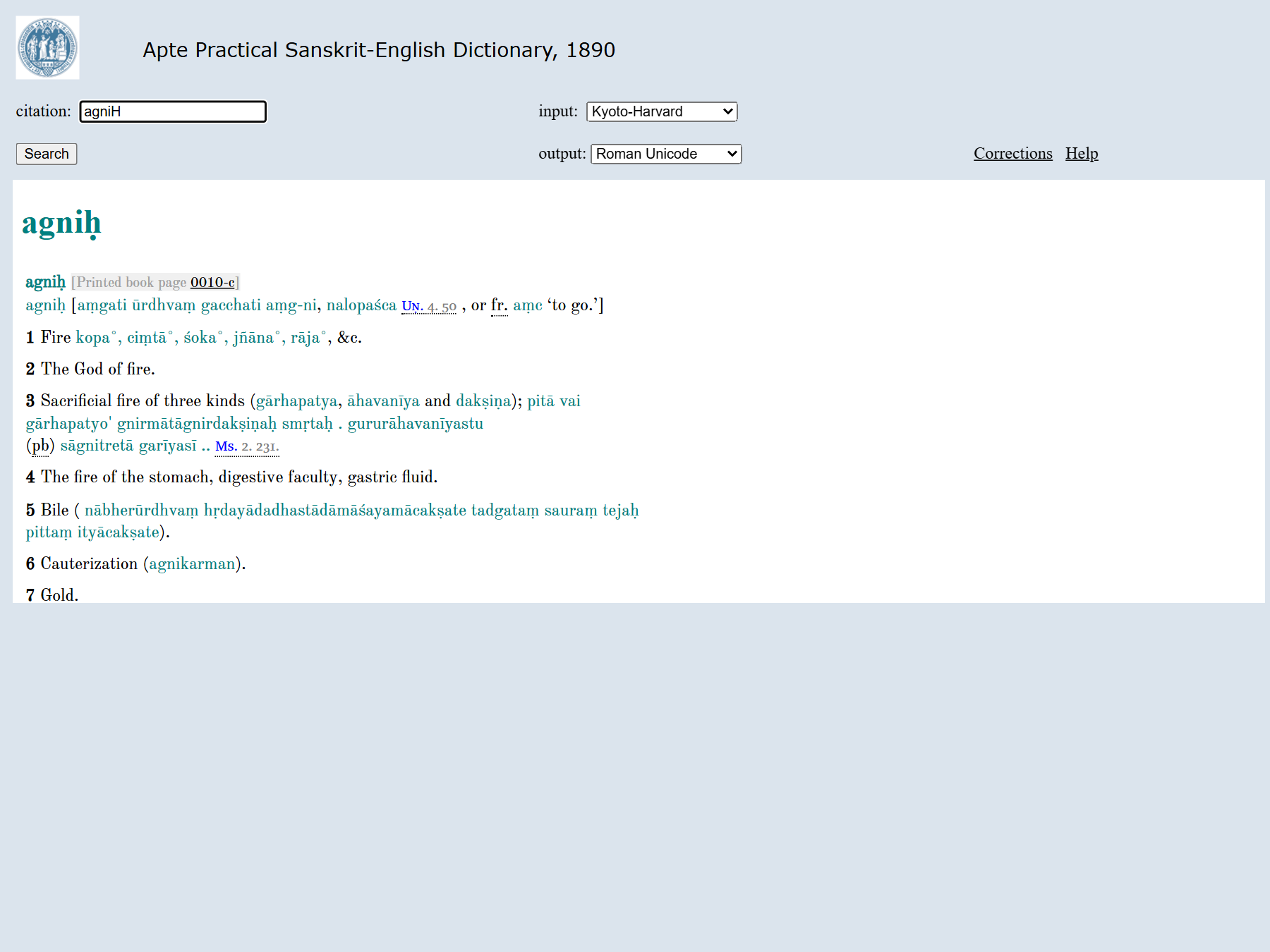
The List and Advanced displays browse and search inside entries — see Search & Display.
Reading an entry
Apte sets Sanskrit in {#…#}, bold in {@…@}, italic in {%…%}, and tags literary
sources with <ls>. The entry aṛṇin "free from debt" (csl-orig/v02/ap90/ap90.txt):
<L>2<pc>0001-c<k1>afRin<k2>afRin
{#afRin#}¦ {%<ab>a.</ab>%} ({#f#} being regarded as a consonant) Not a debtor, free from
debt; {#divasasyAzwame BAge SAkaM pacati yo naraH . afRI cApravAsI ca sa vAricara modate ..#}
<ls>Mb.</ls> The form {#anfRin#} also occurs in this sense.
<LEND>
| In the source | Meaning |
|---|---|
<pc>0001-c | page-column reference (p. 1, col. c) |
{#afRin#} | headword / Sanskrit, in SLP1 |
{%<ab>a.</ab>%} | the grammatical label (adjective), italicised |
<ls>Mb.</ls> | a literary-source citation (Mahābhārata), the link target |
See Data Formats for the full markup reference.
What makes it distinctive
- Built for reading classical texts. Numbered senses, idioms, and translated quotations.
- Appendices. Proper names, geographical names, and a verse/quotation collection.
- Pairs with
AE. Apte's English→Sanskrit dictionary covers the other direction for composition.
Headword key conventions
<k1> = <k2> = SLP1 stem; AP90 marks no Vedic accents anywhere. Page references use a letter for the column.
| Convention | Marker / form | Example | Note |
|---|---|---|---|
| Search key | SLP1, no accent | afRin (ṛṇin) | k1 = k2; no accent marks exist in AP90 |
| Page reference | <pc>page-col (col = letter a/b/c) | <pc>0001-c = p. 1, col. c | Three-column layout |
| Grammar label | {%<ab>a.</ab>%} inside italic | {%<ab>a.</ab>%} = adjective | Nested inside {%…%} italic span |
| Citation | <ls>Mb.</ls> | standard source + locus | Same pattern as MW and other CDSL dicts |
Abbreviations
Literary sources 194
Show first 60 of 194 abbreviations
| Ait Br. | Aitareya Brāhmaṇa (Bombay). |
| Ak. | Amarakoṣa. |
| A. L. | Ānandalaharī. |
| Amaru. | Amaruśataka. |
| Āpast. | Āpastamba. |
| A. R. | Anargharāghava (published in the Kāvyamālā). |
| Āry. S. | Āryavidyāsudhākara (Bombay). |
| Āryā. S. | Āryāsaptaśatī (published in the Kāvyamālā). |
| Aśvad. | Aśvadhāṭī (published in the Subhāṣitaratnākara). |
| Āśval. | Āśvalāyana's Sūtras. |
| Av. | Atharva-veda. |
| Baudhāy. | Baudhāyana. |
| Bg. | Bhagavadgītā (Bombay). |
| Bh. | Bhartṛhari's three Śatakas (the figures 1., 2., 3. after Bh. denoting Śṛṅgāraº, Nītiº, and Vairāgyaº). |
| Bhav. P. | Bhaviṣyottara Purāṇa. |
| Bhāg. | Bhāgavata (Bombay). |
| Bhār. Ch. | Bhāratacampū (Bombay). |
| Bhāṣā P. | Bhāṣāpariccheda. |
| Bhāva P. | Bhāvaprakāśa. |
| Bīj. | Bījagaṇita. |
| Bk. | Bhaṭṭikāvya. |
| B. R. | Bālarāmāyaṇa (Benares). |
| B. and R. | Böthlingk and Roth. |
| Bṛ. S. | Varāhamihira's Bṛhatsaṃhitā. |
| Bṛ. Kath. | Bṛhatkathā. |
| Br. Sūt. | Brahmasūtras. |
| Bṛ. Up. | Bṛhadāraṇyakopaniṣad. |
| Bv. | Bhāminīvilāsa (Bombay). |
| Caṇḍ K. | Caṇḍakauśika. |
| Cand M. | Chandomañjarī. |
| Chandr. | Candrāloka. |
| Chāṇ. | Cāṇakyaśataka. |
| Chāt. | Cātakāṣṭaka (in two parts.) |
| Ch. P. | Caurapañcāśikā. |
| Ch. Up. | Chāndogyopaniṣad |
| Dāy. | Dāyabhāga. |
| Dāy. B. | Dāyabhāga. |
| D. Bhāg. | Devībhāgavata. |
| Dhan. V. | Dhanaṃjayavijaya. |
| Dharm. | Dharmaviveka. |
| Dhūrt. | Dhūrtasamāgama. |
| Dk. | Daśakumāracarita (Bombay). |
| D. R. | Daśarūpa (Hall's Edition). |
| Dṛ. Ś. | Dṛṣṭāntaśataka. |
| Gaut. S. | Gautamasūtra. |
| Gaut. Sūt. | Gautamasūtra. |
| Ghaṭ. | Ghaṭakarparakāvya. |
| Gīt. | Gītagovinda. |
| G. L. | Gaṅgālaharī. |
| G. M. | Gaṇaratnamahodadhi of Vardhamāna. |
| Golādh. | Golādhyāya. |
| H. | Hitopadeśa (Nirṇaya Sāgara Edition). |
| Halāy. | Halāyudha. |
| Hariv. | Harivaṃśa. |
| Hch. | Harṣacarita. |
| H. D. | Haṃsadūta. |
| Hem. | Hemacandra. |
| Iśop. | Īśopaniṣad. |
| J. N. V. | Jaiminīyanyāyamālāvistara (Goldstücker's Edition). |
| K. | Kādambarī (Bombay). |
+ 134 more — see the full list in the source file
Grammatical & general 80
Show first 60 of 80 abbreviations
| A. | Ātmanepada. |
| Atm. | Ātmanepada. |
| a. | Adjective. |
| abl. | Ablative. |
| acc. | Accusative. |
| adv. | Adverb. |
| alg. | Algebra. |
| Arith. | Arithmetic. |
| A. S. | Anglo-Saxon. |
| astr. | Astronomy. |
| astrol. | Astrology. |
| Avyayī. | Avyayībhāva. |
| Bah. | Bahuvrīhi. |
| Caus. | Causal. |
| cf. | Compare. |
| Com. | Commentary. |
| comp. | Compound. |
| dat. | Dative. |
| Den. | Denominative. |
| desid. | Desiderative. |
| du. | Dual. |
| e. g. | Exempli gratia, for example. |
| Eng. | English. |
| Ety. | Etymology. |
| Etym. | Etymology. |
| ety. | Etymology. |
| etym. | Etymology. |
| f. | Feminine. |
| fem. | Feminine. |
| fig. | Figuentative. |
| fr. | From. |
| freq. | Frequentative. |
| gen. | Genitive. |
| Germ. | German. |
| Goth. | Gothic. |
| Gr. | Greek. |
| gram. | Grammar. |
| ibid. | The same. |
| i. e. | id est, that is. |
| ind. | Indeclinable. |
| inf. | Infinitive. |
| instr. | Instrumental. |
| L. | Latin. |
| lit. | Literal. |
| loc. | Locative. |
| m. | Masculine. |
| mas. | Masculine. |
| Mar. | Marāṭhī. |
| Math. | Mathematics. |
| Medic. | Medicine. |
| n. | Neuter. |
| N. | Name. |
| N. B. | Name. |
| Nom. | Nominative. |
| num. a. | Numeral adjective. |
| oft. | Often times. |
| opp. | Opposite of. |
| P. | Parasmaipada. |
| pass. | Passive. |
| pers. | Persian. |
+ 20 more — see the full list in the source file
See also
- Monier-Williams (MW) and Böhtlingk-Roth (PWG)
- The full catalog of all 43 dictionaries
- Abbreviations & Citations — how to cite Apte
- csl-doc ap90.rst