Böhtlingk & Roth, Sanskrit-Wörterbuch (PWG)
Otto Böhtlingk and Rudolph Roth's Sanskrit-Wörterbuch, published by the Imperial Academy
of Sciences in St Petersburg in seven volumes (1855–1875), is the foundational
scholarly Sanskrit lexicon — the "Großes Petersburger Wörterbuch" (the "great"
Petersburg dictionary, hence the code PWG). Monier-Williams and Apte both built on it; for
depth of attestation and citation it is still unmatched. Glosses are in German.
At a glance
| Code | PWG (GitHub repo PWG) |
| Full title | Sanskrit-Wörterbuch (Großes Petersburger Wörterbuch) |
| Authors | Otto Böhtlingk & Rudolph Roth |
| Year / size | 1855–1875 · 7 volumes |
| Direction | Sanskrit → German |
| Accents | Yes (accents are marked, e.g. {#a/kzata#}) |
| Source | csl-orig/v02/pwg/ |
| Open | Basic · List · Advanced · Mobile |
| Data | Downloads · Scans |
| csl-doc | pwg.rst (front matter / preface) |
When to use it
Reach for PWG when you want the deepest scholarly treatment and the fullest citations — it records senses and attestations in detail no later dictionary repeats. Complements within CDSL:
- Böhtlingk shorter (PW) — the same lexicographer's later one-volume-per-letter abridgement; start there if PWG's apparatus is more than you need.
- Monier-Williams (MW) — for English glosses with comparable classical breadth.
- Grassmann (GRA) — for the Ṛg-Veda specifically.
- Reading German is essentially required to use PWG fully.
Looking up a word
- Open the Basic display, choose your input transliteration (see Encoding & Transliteration) and an output script.
- Type the headword — e.g.
agni(fire):
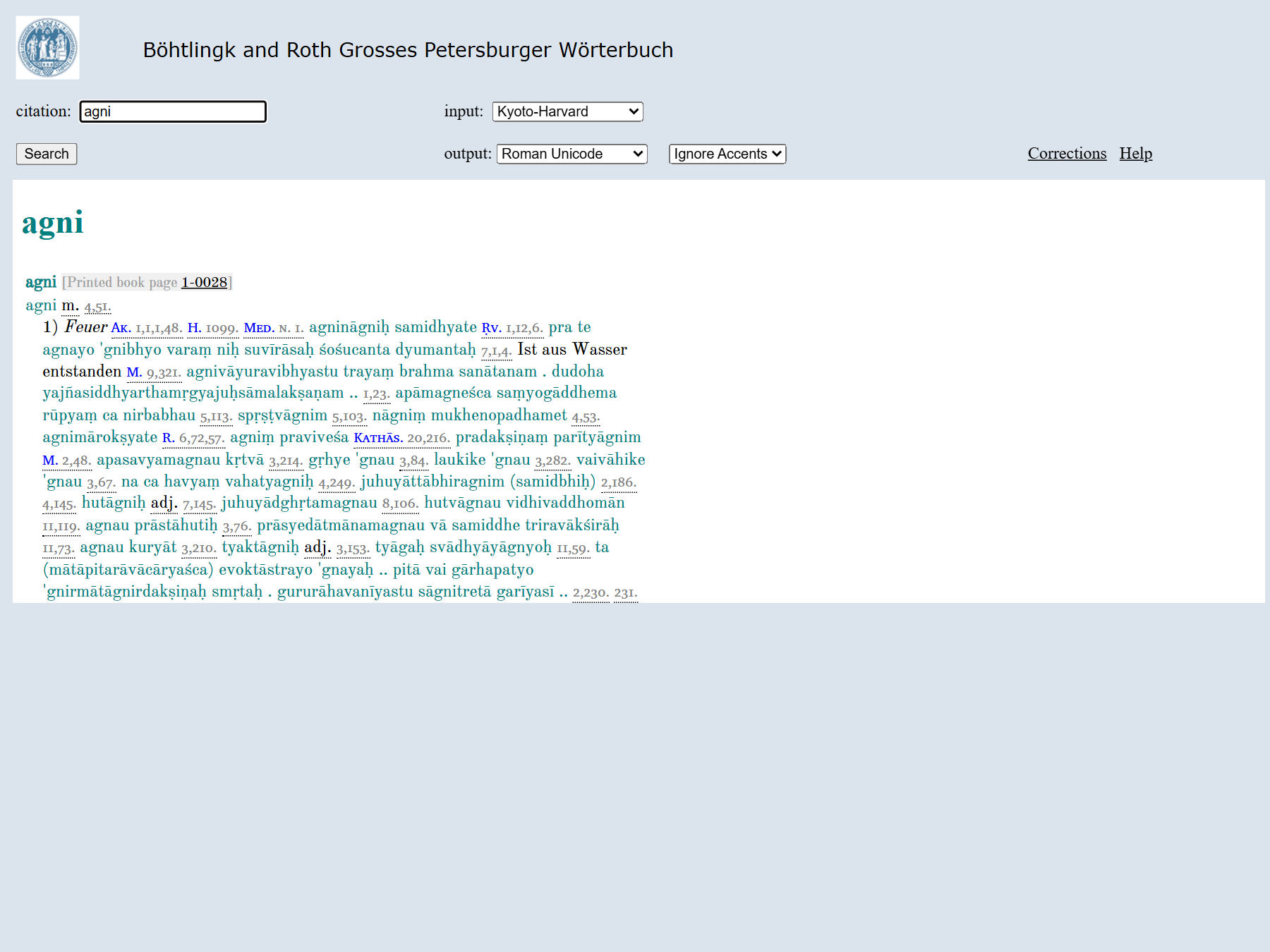
The List display browses neighbouring headwords; Advanced searches inside entry text. See Search & Display.
Reading an entry
PWG entries pack senses into nested <div> subdivisions, with Sanskrit set in {#…#},
German glosses in {%…%}, and literary sources in <ls>. A fragment of the pronoun a
(csl-orig/v02/pwg/pwg.txt):
<L>2<pc>1-0001<k1>a<k2>a<h>2
2. {#a#}¦ Pronominalstamm:
<div n="2"> a) der 1sten Person, enthalten in {#aha/m, AvA/m, …#} …
<div n="2">— b) der 3ten Person; <lex>f.</lex> {#A#} … <ls>ṚV.</ls> <ls>P. 6,1,116.</ls> …
<LEND>
| In the source | Meaning |
|---|---|
<pc>1-0001 | volume-page reference in the print (vol. 1, p. 1) |
{#…#} | Sanskrit, stored in SLP1 |
{%…%} | German gloss |
<div n="…"> | a numbered/lettered sense subdivision |
<ls>ṚV.</ls>, <ls>P. 6,1,116.</ls> | literary-source citations (Ṛg-Veda, Pāṇini), the link targets |
See Data Formats for the full markup reference.
What makes it distinctive
- The reference of record. Its citations and sense distinctions are the substrate later Sanskrit–English dictionaries condensed.
- Citation density. The heavy use of
<ls>source references is exactly what the project's "Dictionary to Book" link-target work makes clickable — see Issue Taxonomy. - German scholarship. Definitions, grammatical notes, and discussion are in German.
Citation link coverage
That <ls> citation apparatus is being made clickable. Measured over the ~51 PWG
roots translated so far for the RU/EN article site
(a subset, not the whole dictionary), 83% of the 50,065 citation occurrences
resolve to a Cologne target — 69% to a page scan, 14% to HTML
digital text (Ṛg-Veda, Atharva-Veda, Pāṇini) — while 446 cited works remain
un-digitised (chiefly Suśruta, the Upaniṣads, the Śrauta/Gṛhya sūtras) and so
cannot be linked from anywhere. (Snapshot: 02-07-2026.)
Full, always-current reports live in the PWG repo under
pwg_ls/pwg_ru_coverage/:
coverage index
· uncovered works
· covered vs uncovered + frontier.
Headword key conventions
<k1> is the SLP1 stem (search key); <k2> is commonly identical but may carry a udātta /. Page references encode volume-page — the seven-volume structure of the print.
| Convention | Marker / form | Example | Note |
|---|---|---|---|
| Search key | SLP1, accent-stripped stem | aMSa | What you type to search |
| Udātta (some entries) | / on the vowel in <k2> | a/MSa | Not all entries mark the accent in <k2> |
| Homonyms | <h> integer | <k1>a<k2>a<h>2 | Multiple records share the same <k1> |
| Sense structure | <div n="…"> labelled subdivisions | <div n="2"> a) … | Numbered and lettered sense divisions in the body |
| Page reference | <pc>vol-page | <pc>1-0001 = vol. 1, p. 1 | Volume number prefixes the page |
Abbreviations
pref legend Preface abbreviation legend joined to body <ls> counts (395 keys · 340 attested in body · 55 pref-only residual). Sorted by citation frequency.
Literary sources (pref × body) 393
Show top 60 of 393 by body count
| Abbr. | Expansion (pref) | Body |
|---|---|---|
| R. | Râmâjana. Ohne eine nähere Angabe ist bei den zwei ersten Büchern die Ausgabe von Schlegel (Gild. Bibl. 84), bei den vier letzten die von Gorresio (Gild. Bibl. 85) gemeint. review | 234,443 |
| H. | Hemakandra's Abhidhânakintâmaṇi, ein systematisch angeordnetes synonymisches Lexicon. Herausgegeben, übersetzt und mit Anmerkungen begleitet von Otto Böhtlingk und Charles Rieu. St. Petersburg 1847. review | 197,887 |
| N. | Nalopâkhjâna in Böhtlingk's Chrestomathie (Gild. Bibl. 49). Die Bopp'sche Ausgabe (Gild. Bibl. 99) ist durch N. (Bopp) bezeichnet. review | 90,941 |
| M. | Manu's Gesetzbuch in der Ausg. von Loiseleur Deslongchamps (Gild. Bibl. 289). review | 83,397 |
| MBh. | Mahâbhârata, ed. Calc. (Gild. Bibl. 93). Von S. 521 des Wörterbuchs sind die drei ersten Bücher, von S. 601 auch die fünf letzten, von ऋ an auch das 13te Buch ausgebeutet worden. review | 67,272 |
| RV. | Ṛgveda. Es wird nach Maṇḍala, Sûkta und Ṛḱ citirt. Rosen zu RV. verweist auf die Anmerkungen in: Rigveda-Sanhita, liber primus, sanscritè et latinè; edidit Fridericus Rosen. London 1838. review | 58,146 |
| Bhag. | Bhagavadgîtâ, Ausg. von Schlegel (Gild. Bibl. 116). review | 33,406 |
| Bhâg. P. | Bhâgavatapurâṇa, nach Anführungen im VP. und ÇKDr. Von ऋ an sind die 9 von Burnouf edirten Skandha (Gild. Bibl. 125) ausgebeutet worden. review | 30,744 |
| AK. | Amarakosha nach der Ausgabe von Colebrooke und Loiseleur Deslongchamps (Gild. Bibl. 251. 253). review | 28,273 |
| Kathâs. | Kathâsaritsâgara, ed. Brockhaus (Gild. Bibl. 237). review | 25,078 |
| AV. | Atharvavedasaṃhitâ, herausg. von R. Roth und W. D. Whitney. Berlin bei F. Dümmler. 1855. 8°. In den ersten Bogen des Wörterbuchs finden sich mehrere Citate, deren Zahlen mit der in der Ausgabe angenom review | 21,528 |
| Śat. Br. | Çatapathabrâhmaṇa in der Mâdhjandina-Çâkhâ, with extracts made from the commentaries of Sâjana, Harisvâmin and Dvivedaganga, edited by Dr. Albrecht Weber. Berlin Ferd. Dümmler's Buchhandlung. London W review | 20,941 |
| Suśr. | Suçruta, ed. Calc. (Gild. Bibl. 367); citirt nach Band, Seite und Zeile. Den Titel der Hessler'schen Uebersetzung s. bei Gild. Bibl. 368. review | 20,306 |
| an. | Anekârthasaṃgraha (s. H. an.). review | 20,269 |
| St. | Stenzler. review | 19,558 |
| Hariv. | Harivaṃça im 4ten Bande des MBh. Aus diesem Werke haben wir die Nomina propria mit Benutzung des Index in der Langlois'schen Uebersetzung (Gild. Bibl. 122) aufgenommen. review | 15,689 |
| Varâh. Bṛh. | Varâhamihira's Bṛhaǵǵâtaka. review | 15,212 |
| Med. | Medinîkosha, ed. Calc. (Gild. Bibl. 258). Die Wörter sind zunächst nach dem letzten Consonanten im Worte angeordnet: also कान्त (k), खान्त (kh), गान्त (g) u. s. w. Die Partikeln (avjaja) bilden einen review | 15,136 |
| Varâh. Bṛh. S. | Varâhamihira's Bṛhatsaṃhitâ. review | 14,323 |
| H. an. | Hemakandra's Anekârthasaṃgraha, ed. Calc. (Gild. Bibl. 259). review | 9,986 |
| Ragh. | Raghuvaṃça, ed. Stenzler (Gild. Bibl. 134). review | 9,870 |
| Gorr. | Gorresio. review | 8,921 |
| Trik. | Trikâṇḍaçesha, ed. Calc. (Gild. Bibl. 258). review | 8,870 |
| Kâty. | Kâtjâjana. review | 8,789 |
| Kâty. Śr. | Kâtjâjana's Çrautasûtrâni. 26 Adhjâja. Hdschr. review | 8,694 |
| gaṇa. | S. den alphabetisch geordneten gaṇapâṭha in Böhtlingk's Ausgabe des Pânini (Gild. Bibl. 244), S. LXXVII—CXXV. review | 8,419 |
| VS. | Vâǵasanejisaṃhitâ. The Vâjasaneyi-Sanhitâ in the Mâdhjandina — and the Kâṇva-Çâkhâ with the commentary of Mahîdhara, edited by Dr. Albrecht Weber. Berlin Ferd. Dümmler's Verlagshandlung. London Willia review | 8,042 |
| Ind. St. | Weber's Indische Studien. review | 7,687 |
| TS. | Taittirîjasaṃhitâ. 7 Kâṇḍa, eingetheilt in Praçna, Anuvâka und Kaṇḍikâ. Die letzten bezeichnen nicht Satzabschnitte, sondern umfassen je 50 Wörter. Hdschr. review | 6,912 |
| Mârk. P. | Mârkâṇḍejapurâṇa in der Bibliotheca indica. review | 6,489 |
| Çâk. | Çikuntala, das Drama in der Ausgabe von Böhtlingk (Gild. Bibl. 191). Eine einfache Zahl bezeichnet den Çloka, eine doppelte — Seite und Zeile. review | 6,006 |
| SV. | Sâmaveda. Die Hymnen des Sâma-Veda, herausgegeben, übersetzt und mit Glossar versehen von Theodor Benfey. Leipzig 1848. 8°. Die Eintheilung Benfey's ist beibehalten. review | 5,429 |
| Ait. Br. | Aitarejabrâhmaṇa. Citirt nach den 8 Pańḱikâ (einer äusseren Abtheilung, in welche die 40 nach sachlichen Rücksichten gebildeten Adhjâja zerlegt sind) und den innerhalb der Pańḱikâ durchlaufenden Kapit review | 5,223 |
| v. l. | varia lectio. review | 4,978 |
| Arǵ. | Arǵunasamâgama, ed. Bopp (Gild. Bibl. 106). review | 4,871 |
| Verz. d. B. H. | Weber's Verzeichniss der Berliner Sanskrit-Handschriften. Bildet den ersten Band von: Die Handschriften-Verzeichnisse der Königlichen Bibliothek, herausgegeben von dem Königlichen Oberbibliothekar, Ge review | 4,677 |
| Sâh. D. | Sâhitjadarpaṇa, auf den 10 ersten Bogen nach der Ausgabe von 1828 (Gild. Bibl. 264), auf den folgenden Bogen, wenn nicht die Jahreszahl 1828 ausdrücklich bemerkt wird, nach der Ausgabe von Röer in der review | 4,630 |
| Hit. | Hitopadeça, ed. Schlegel und Lassen (Gild. Bibl. 225). Eine darauf folgende römische Zahl bezeichnet das Buch, eine arabische — die Seite; die zweite Zahl bezeichnet dort den Çloka, hier die Zeile. review | 4,284 |
| VP. | Vishṇupurâṇa. Es wird die Wilson'sche Uebersetzung (Gild. Bibl. 133) citirt. review | 4,143 |
| Nir. | Jâska's Nirukta sammt den Nighaṇṭava's herausgegeben und erklärt von Rudolph Roth. Göttingen 1852. review | 3,747 |
| TBr. | Taittirîjabrâhmaṇa. review | 3,424 |
| Hâr. | Hârâvalî, ed. Calc. (Gild. Bibl. 258). review | 2,937 |
| Colebr. Misc. Ess. | Colebrooke's Miscellaneous Essays. 2 Bände. London 1837. review | 2,771 |
| Dhâtup. | Dhâtupâṭha in Westergaard's Radices (Gild. Bibl. 42). review | 2,768 |
| Śâńkh. Śr. | Çâńkhâjana's Çrautasûtrâni. review | 2,728 |
| Kumâras. | Kumârasaṃbhava, ed. Stenzler (Gild. Bibl. 136). review | 2,706 |
| Lâṭy. | Lâṭjâjana's Sûtra zum SV. Hdschr. review | 2,608 |
| Vârtt. | Vârttika von Kâtjâjana in Böhtlingk's Ausg. des Pâṇini. review | 2,419 |
| Megh. | Meghadûta, ed. Gildemeister (Gild. Bibl. 151). review | 2,369 |
| Âśv. Śr. | Âçvalâjana's Çrautasûtrâni in 12 Adhjâja. Handschrift. review | 2,295 |
| LA. | Lassen's Anthologie (Gild. Bibl. 48). review | 2,051 |
| Chând. Up. | Khândogjopanishad, nach der Ausgabe von Röer in der Bibliotheca indica. review | 2,049 |
| Wils. | Wilson's Wörterbuch (Gild. Bibl. 37). review | 2,024 |
| Sûryas. | Sûrjasiddhânta, nach Anführungen in Haughton, A Dict. Beng. and S. review | 1,867 |
| Âśv. Gṛhy. | Âçvalâjana's Gṛhjasûtrâni in 4 Adhjâja. Hdschr. review | 1,751 |
| Vyutp. | Vjutpatti oder Mahâvjutpatti (s. Mél. asiat. II, 382), ein sanskrit-tibetisches Wörterbuch aus dem Taṅgur (Bd. 123 der Sûtra, S. 223—377). Die Mittheilungen aus diesem Werke nebst andern auf den Budhi review | 1,741 |
| Bṛh. Âr. Up. | Bṛhadâraṇjakopanishad, nach der Ausgabe von Röer in der Bibliotheca indica. review | 1,595 |
| Kâṭh. | Kâṭhaka-Recension des Jaǵ. V. review | 1,579 |
| Rt. | Ṛtusaṃhâra, ed. Bohlen (Gild. Bibl. 135). review | 1,534 |
| Vet. | Vetâlapaṅḱaviṃçati in Lassen's Anthologie (LA). review | 1,531 |
+ 333 more in the legend store (top 60 by body citation count shown).
Grammatical & general 1
| Abbr. | Expansion (pref) | Body |
|---|---|---|
| P. | Pâṇini's acht Bücher grammatischer Regeln (Gild. Bibl. 244). | 95,965 |
Meta / unclassified 1
| Abbr. | Expansion (pref) | Body |
|---|---|---|
| Sch. oder Schol. | Scholiast. spacing | 0 |
See also
- How to read Böhtlingk–Roth (PWG) — the dictionary-literacy reading pack: the Vorwort's declarations, the top sigla by measured frequency, the manuscript sources
- Böhtlingk shorter (PW) — the abridged recension
- The full catalog of all 43 dictionaries
- Abbreviations & Citations — how to cite PWG
- OCR'd prefaces — the front matter transcribed, with English & Russian translations
- csl-doc pwg.rst