Created: 09-11-2026 · Last updated: 09-11-2026
Nyāyakośa (NYBJ)
NYBJ is the Nyāyakośa — "dictionary of technical terms of Indian philosophy" —
the principal reference for Nyāya-school vocabulary, composed by
Mahāmahopādhyāya Bhīmācārya Jhalakīkara (third edition, 1928; revised and
re-edited by Mahāmahopādhyāya Vāsudev Shāstrī Abhyāṅkar). It defines
2,479 technical terms from the Nyāya-sūtras of Gautama and the later logical
literature — in Sanskrit, with the definitions attributed to the schools that
use the terms.
At a glance
| Code | NYBJ (source in csl-orig/v02/nybj; no separate repo) |
| Full title | Nyāyakośa or Dictionary of Technical Terms of Indian Philosophy |
| Author | Mahāmahopādhyāya Bhīmācārya Jhalakīkara; re-edited by Mahāmahopādhyāya Vāsudev Shāstrī Abhyāṅkar |
| Year / size | 1928 (third edition, Bhandarkar Oriental Research Institute, Poona) · ~1,154 pages · 2,479 records |
| Direction / language | Technical terms of Indian philosophy; definitions in Sanskrit |
| Accents | No |
| Source | csl-orig/v02/nybj/ · scan (Internet Archive) |
| Open | Basic · List · Advanced · Mobile |
| Data | Downloads |
| Digital edition | Ed. Dr. Dhaval Patel (University of Cologne, 2026) |
Unlike most CDSL dictionaries, NYBJ's web application lives under a 2026 path
(/scans/NYBJScan/2026/web/…), not the usual 2020. There is no csl-doc page for it yet.
When to use it
Reach for NYBJ when a philosophical term — akarmaka, anumāna, akṣara —
is used in a darśana text and you need its definition as the tradition gives it,
not a translator's gloss. Its definitions name the schools (Nyāya, Vedānta, Mādhyamika,
Vallabha…) whose usage they follow. It complements Vācaspatyam (VCP) — the
encyclopedic kośa — with a tighter, Sanskrit-only treatment of philosophical
vocabulary. For ordinary Sanskrit words use Monier-Williams (MW).
Looking up a word
- Open the Basic display and pick your input transliteration (see
Encoding & Transliteration). Type the headword — e.g.
akarmakaH(akarmaka, "intransitive"):
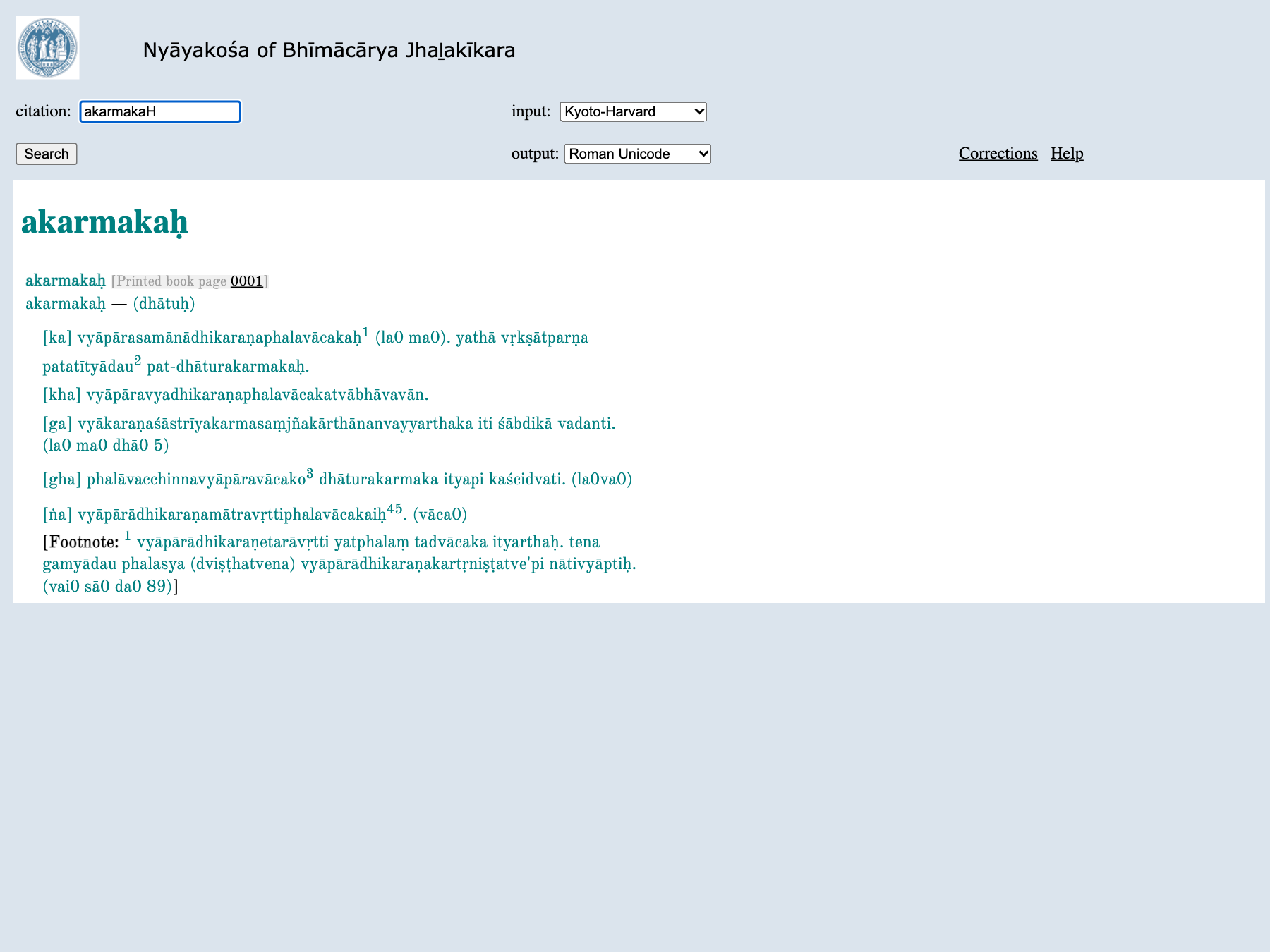
The List display browses neighbouring headwords; the Advanced display searches inside definitions. See Search & Display.
Reading an entry
The first record — aṃhaspati ("the month in which the sun does not cross"),
from csl-orig/v02/nybj/nybj.txt:
<L>0001<pc>0001<k1>aMhaspatiH<k2>aMhaspatiH
;p{0001}
aMhaspatiH — kzayamAsaH. yasminmAse na saMkrAntiH saMkrAntidvayameva vA. saMsapahaspatI mAsAvaDimAsaSca ninditAH.. (pu0 ci0 pf0 16)
<LEND>
| In the source | Meaning |
|---|---|
<L>0001<pc>0001 | Cologne record id 1, on printed page 1 |
<k1> = <k2> | search key vs display key, both SLP1 (aMhaspatiH) — headwords carry no accent marks |
;p{0001} | print page marker |
aMhaspatiH — kzayamAsaH… | the Sanskrit definition, introduced by the headword and an em-dash |
(pu0 ci0 pf0 16) | source citations in sigla: the works and passages the definition draws on |
Longer definitions — akarmaka (intransitive) carries five footnotes —
attribute competing definitions to schools in square brackets ([ka], [kha],
[ga], [gha], [ña]) and unfold them in <f id="…"> notes (see Data Formats
for the markup reference).
What makes it distinctive
- Definitions in Sanskrit. NYBJ glosses a term by stating it in the tradition's own language, then citing the works it follows — not by translating into English. You do not look it up to read Sanskrit but to reason in it.
- Schools named inside the entry. A single headword can carry several
definitions, each tagged
[ka],[ga],[na]for the school whose usage it records — the entry akṣara collects six senses, from the Māyāvādins to the Vallabhiyas — so the disagreement between traditions is itself the entry. - A modern critical edition. The digitized 1928 text is the Bhandarkar Oriental Research Institute's third edition (No. XLIX), revised by Vāsudev Shāstrī Abhyāṅkar — the working reference for Nyāya studies since.
- The newest arrival on CDSL (2026). Scans under a 2026 path, digital edition by Dr. Dhaval Patel, full B/L/A/M displays.
Headword key conventions
NYBJ is an alphabetical headword dictionary — search keys are plain SLP1, and
the nominative is spelled out with a final visarga (-H), matching the printed
akarmakaH. Definitions are given in Sanskrit.
| Convention | Marker / form | Example | Note |
|---|---|---|---|
| Search key | <k1> (SLP1, no accent) | akarmakaH | With final visarga for nominals |
| Display key | <k2> (same SLP1 form) | akarmakaH | k1 = k2; no accents to choose |
| Definition | headword — Sanskrit definition | aMhaspatiH — kzayamAsaH… | Definitions are Sanskrit, not English |
| School tags | [ka], [ga], [na] | [ka] vyApAravyaDikaraRa… | The school whose definition follows |
| Footnotes | [^n] → <f id="n">…</f> | [^1] | The note unfolds the school debate |
| Source sigla | (xx0 yy0 pf0 16) | (vAtsyA0 2. 1. 46) | Abbreviated works the definition rests on |
| Page markers | <pc>PPPP, ;p{…} | <pc>0001 | Four-digit printed page |
Abbreviations
No machine-readable abbreviation list yet; the legend lives in the scanned front matter.
See also
- Vācaspatyam (VCP) — the encyclopedic Sanskrit kośa · Mahābhārata Cultural Index (MCI) — the cultural companion
- Monier-Williams (MW) — for English glosses of ordinary vocabulary
- The full catalog of all 45 catalogued dictionaries
- Abbreviations & Citations — how to cite a dictionary